
ProSonix
Paper and Pulp
Wet End Starch Cooking
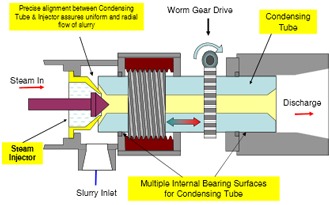 Wet end starch – Starch added at the wet end to the paper slurry can help increase the sheet strength. The starch will also act as binder for various additives and fillers such as Alum, Calcium carbonate and TiO2. When properly cooked, starch swells and its viscosity increases. Wet end starch is produced to give it a cationic charge. This allows the cooked starch natural adhesion properties to create a bond with the paper fibers. By connecting the fibers and additives in small ‘clumps’, leaving relatively clean water in between (flocculation), faster drainage of water leading to increased wire and machine speeds.
Green Liquor Heating
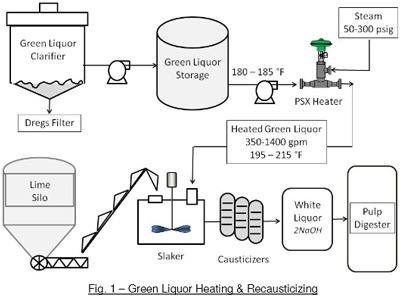 Kraft pulp mills produce pulp from wood chips. Within the pulp production, a chemical process produces green liquor. Green liquor is a combination of recovery boiler smelt and dilute white liquor. Dregs are removed and liquor is sent to recausticising tanks to produce white liquor. Flows vary based on the size of the pulp mill and can range from 350-1400 gpm.
 White water is a fine particle slurry used throughout the paper making process. Its name derives from fine fiber particles in the water that give it a milky white appearance. White water drains from the paper stock into a pit below the paper machine and is used for a variety of uses in the paper making process.
Wastewater
Solvent Recovery and Separation
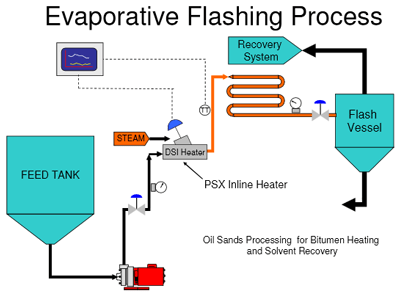 Oil sands processing in Northern Canada utilizes a variety of solvents and naphtha to assist in the separation of the Bitumen from the water and sand. These fluids can help promote chemical reactions, accelerate processing time, and reduce processing costs. Many of these must recovered due to their high costs, importance of water recovery, or issues associated with release of the chemicals to the environment.
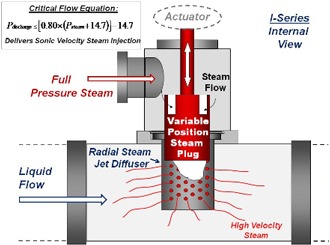
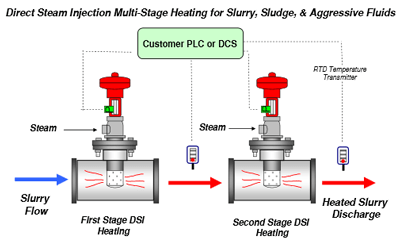 Inline process heating with Direct Steam Injection has multiple applications in a variety of process and utility applications. Many applications such as mineral processing, pulp and fiber slurry pre-treatment, oil sands mining and others are not well suited for traditional methods of heating. Typical challenges encountered are corrosive fluids, abrasive particulate, viscosity changes, plugging and fouling, eating for water, slurry, sludge, and aggressive fluid heating applications. Direct Steam Injection for Inline Heating is a very good choice for a variety of applications. One of the fundamental principals for efficient and reliable steam injection is the ability to produce and deliver high velocity steam. High velocity steam is what assures rapid and complete condensation and mixing of the steam in the fluid.
 More and more agricultural and dairy farms as well as beef, hog and poultry operations are considering the use of anaerobic digestion for biogas production. These operations typically produce a significant amount of organic matter in the form of manure. Anaerobic digestion is a biological process that breaks down organic solids. Manure can be processed in anaerobic digesters and the byproduct is methane gas. The methane gas can be captured, stored and used to run electrical generators and boilers for use in the farm operations. Heat exchangers can face the following challenges when heating sludge: