We offer a range of steam injection solutions designed for efficient, direct-contact heating across a wide variety of industrial processes. Our steam injectors provide rapid and uniform heat transfer by injecting steam directly into liquids, helping to achieve precise temperature control, improved heating efficiency, and reduced energy consumption.
Our steam injection technology is suitable for numerous applications, including hot water supply, tank heating, inline process water heating, boiler feedwater heating, starch processing, biofuel production, food processing, mining, and wastewater treatment. Whether used for heating process fluids, supporting production processes, or recovering waste steam, these solutions help optimise thermal performance and overall system efficiency.
Designed for demanding industrial environments, our steam injectors offer reliable performance, efficient operation, and versatile application across industries such as power generation, food and beverage, pulp and paper, mining, and manufacturing. Whether you require heating for an existing system or a specialised process application, we provide effective steam injection solutions backed by technical expertise and support.
Oil sands processing in Northern Canada utilizes a variety of solvents and naphtha to assist in the separation of the Bitumen from the water and sand. These fluids can help promote chemical reactions, accelerate processing time, and reduce processing costs. Many of these must recovered due to their high costs, importance of water recovery, or issues associated with release of the chemicals to the environment.
Inline process heating with Direct Steam Injection has multiple applications in a variety of process and utility applications. Many applications such as mineral processing, pulp and fiber slurry pre-treatment, oil sands mining and others are not well suited for traditional methods of heating. Typical challenges encountered are corrosive fluids, abrasive particulate, viscosity changes, plugging and fouling, eating for water, slurry, sludge, and aggressive fluid heating applications. Direct Steam Injection for Inline Heating is a very good choice for a variety of applications. One of the fundamental principals for efficient and reliable steam injection is the ability to produce and deliver high velocity steam. High velocity steam is what assures rapid and complete condensation and mixing of the steam in the fluid.
More and more agricultural and dairy farms as well as beef, hog and poultry operations are considering the use of anaerobic digestion for biogas production. These operations typically produce a significant amount of organic matter in the form of manure. Anaerobic digestion is a biological process that breaks down organic solids. Manure can be processed in anaerobic digesters and the byproduct is methane gas. The methane gas can be captured, stored and used to run electrical generators and boilers for use in the farm operations. Heat exchangers can face the following challenges when heating sludge:
More and more agricultural and dairy farms as well as beef, hog and poultry operations are considering the use of anaerobic digestion for biogas production. These operations typically produce a significant amount of organic matter in the form of manure. Anaerobic digestion is a biological process that breaks down organic solids. Manure can be processed in anaerobic digesters and the byproduct is methane gas. The methane gas can be captured, stored and used to run electrical generators and boilers for use in the farm operations. Heat exchangers can face the following challenges when heating sludge:
Live steam used to provide heat for heat exchangers creates hot spots where sludge can burn and build-up plugging the heat exchanger tubes. This increases maintenance costs and an increased pressure drop across the heat exchanger
Upgrading from mesophillic to thermophilic often require multiple heat exchangers in series to achieve the necessary temperature rise
Increased pressure drop adds demand to the sludge pumps thus increasing energy usage
Temperature control problems can be present as there is a lag time from slurry entering and then being discharged
To overcome these challenges, Direct Steam Injection (DSI) is a very good approach. There are correct ways to apply DSI and approaches that may not produce desirable results. One of the key factors to successful DSI is to inject steam at sonic velocity to achieve choked flow.
Spargers, Fixed Eductors &Venturi Style DSI
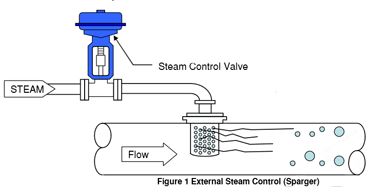
These units use a fixed nozzle to inject steam. Steam control is attempted via an externally modulated steam control valve. With an externally modulated steam injecton the steam pressure is adjusted to control the flow rate of steam with a control valve.
Problems arise when the steam pressure has dropped to a point where the steam flow is no longer choked. This can be seen most often at start up and shutdown of externally modulated steam injectors in the form of noise, vibration and hammering. With an external steam valve, there is always a pressure drop before the steam reaches the injector.
The use of external steam control devices to control the steam flow by modulating the steam pressure can lead to excessive steam hammering and vibration. Steam hammering and vibration often result from poor mixing and condensing of the steam. As temperature demand drops, steam pressure drops, lowering the steam velocity and potentially causing instability. Uncondensed steam bubbles will typically collapse when it comes in contact with a cold pipe wall in the liquid piping. When these bubbles collapse, the slurry rushes in to fill the void and impacts the pipe wall. In some cases this will result in some pinging noise and in severe cases, steam hammering and vibration.
PSX DSI Heater Solution
The PSX heater uses a unique method of steam injection via an integral steam control device. The key to efficient, safe and predictable steam injection is to inject steam at sonic velocity to achieve choked flow. All steam injectors need to operate in a choked flow manner for good, non-violent mixing. The PSX heater is an internally modulated injection heater that varies the mass flow rate of steam by changing the area through which the steam may pass. This type of modulation allows the full steam pressure to always be present at the point of injection regardless of the plug position. The PSX heater has an integrated Pneumatic Actuator that allows the engineered steam diffuser opening to vary according to the temperature demand.
Flow rates can range from 1 – 5,000 gpm. The PSX heater has a high heating capacity and can achieve a temperature rise of up to 250°F (121°C) in a single pass through the heater.
Key PSX Heater Direct Steam Injection Benefits
Stable operation due to the internal steam modulation design which controls the steam mass flow and not the steam pressure thus eliminating steam hammering and vibration issues
Low maintenance due to the PSX heater’s self cleaning design
Low pressure drop reduces demand on the sludge pumps lowering energy costs
Better temperature control allows for a more reliable heating process (typically +/- 1%)
Reduced installation and operational costs with the elimination of the condensate return system
Direct mechanical control of the steam injector allows for linear process heating control
Control is maintained by the plant PLC/DCS or local controller with no proprietary software required
PSX heater can be installed in the piping requiring no floor space

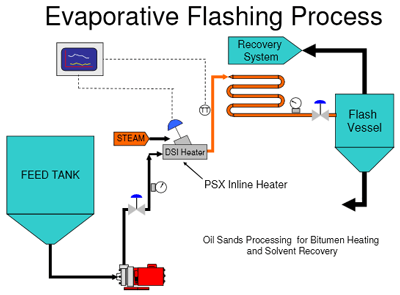 Oil sands processing in Northern Canada utilizes a variety of solvents and naphtha to assist in the separation of the Bitumen from the water and sand. These fluids can help promote chemical reactions, accelerate processing time, and reduce processing costs. Many of these must recovered due to their high costs, importance of water recovery, or issues associated with release of the chemicals to the environment.
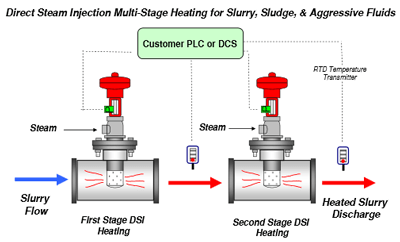 Inline process heating with Direct Steam Injection has multiple applications in a variety of process and utility applications. Many applications such as mineral processing, pulp and fiber slurry pre-treatment, oil sands mining and others are not well suited for traditional methods of heating. Typical challenges encountered are corrosive fluids, abrasive particulate, viscosity changes, plugging and fouling, eating for water, slurry, sludge, and aggressive fluid heating applications. Direct Steam Injection for Inline Heating is a very good choice for a variety of applications. One of the fundamental principals for efficient and reliable steam injection is the ability to produce and deliver high velocity steam. High velocity steam is what assures rapid and complete condensation and mixing of the steam in the fluid.
 More and more agricultural and dairy farms as well as beef, hog and poultry operations are considering the use of anaerobic digestion for biogas production. These operations typically produce a significant amount of organic matter in the form of manure. Anaerobic digestion is a biological process that breaks down organic solids. Manure can be processed in anaerobic digesters and the byproduct is methane gas. The methane gas can be captured, stored and used to run electrical generators and boilers for use in the farm operations. Heat exchangers can face the following challenges when heating sludge: