Tank Heating
Jet Sparger Optimisation
Jet Sparger Optimisation Heating of water tanks or vessels in many applications is done to stage hot water for use in production, cleaning, line and filter flushing and a number of other uses. Common methods of tank heating are through the use of heat exchangers, eductors or spargers. The incoming water is usually around 45°F – 60°F (7°C – 16°C) and is typically heated anywhere from 100°F – 150°F (38°C – 66°C) for applications involving sanitizing or cleaning.
Tanks and vessel systems typically heated by the use of heat exchangers, eductors, and steam spargers can experience the following issues:
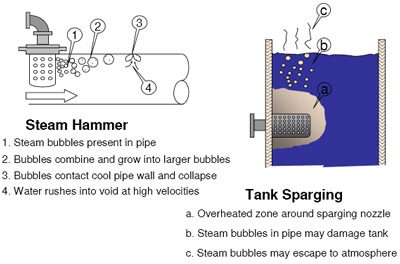
- Spargers and eductors may damage the tank because of the sometimes violent nature of the condensation process
- Using an external steam control valve to control steam pressure produces low velocity steam which leads to inefficient steam mixing and condensation. Uncondensed steam will either produce steam hammering or escape to atmosphere leading to energy losses
- Heat exchangers require a condensate return system. Plug and ineffective steam traps along with flash releases can lead to energy losses and maintenance issues
- Heating of water can leave mineral and scale build-up that causes maintenance and performance problems for heat exchangers and spargers
- Some sparger devices use passive springs and tube assemblies that tend to stick, resulting from scale build-up, causing temperature control problems
Jet Diffuser Efficiency
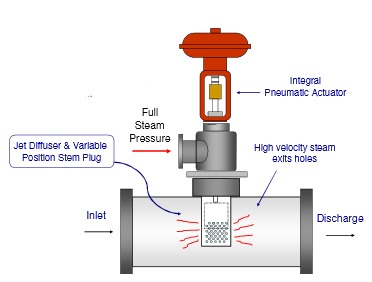
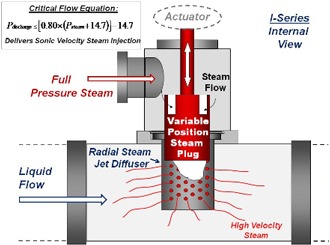
High velocity steam delivery assures complete mixing of steam, reducing occurrences of vibration and saves energy losses from uncondensed steam escaping. Integral stem plug eliminates need for steam pressure control valve.
Single or Multiple Jet Sparger Configurations
A single Jet Sparger can be used for small tanks. When heating larger tanks, or if a higher temperature rise is required, multiple PSX Spargers (2-4) can be placed around the tank. Multiple Jet Sparger configurations also allow for rapid heat-up, and when desired temperature is achieved, (1) PSX Jet Sparger can be operated for trim temperature control.
PSX Heater Solution
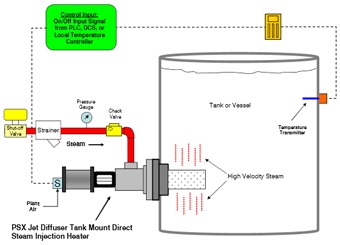
Install the PSX Jet Diffuser Tank Mount Sparger on the tank wall to the heat the tank until the tank reaches a steady state temperature. Various size tanks can be accommodated with single or multiple Jet Sparger arrangements.
The PSX heater has a high heating capacity which accelerates tank heat-up time over the time it takes conventional steam sparging. Once the desired tank temperature is achieved, a single the PSX heater steam injector can be operated to allow for trim temperature control of the tank until the desired tank temperature achieved. Injection of high velocity steam minimises improves condensation and mixing, thus structural damage to the tank from the sparger can be eliminated. As the PSX heater utilises sonic velocity steam injection, scale and mineral build issues in the steam injector is eliminated.
The tank temperature can be controlled via a tank sensor, a discharge sensor, a cascade control loop or in a variety of configurations allowing consistent precise temperature control. The internal steam control design of the PSX heater controls the steam mass flow and not the steam pressure, thus eliminating steam hammering and vibration.
Note: Use of tank sparging for applications above 150°F (66°C) may be inefficient and lead to extended heating times. For tank heating applications above 150°F (66°C), the PSX Inline heater is recommended.
Key Direct Steam Injection Benefits
- Energy savings resulting from more efficient steam condensation, faster tank heat-up and reduced heat loss to atmosphere
- Lower maintenance due to the PSX Jet Spargers self cleaning design
- Improved safety due to better steam injection heating methods (elimination of steam hammering)
- Better temperature control allows for a more reliable heating process
- Reduced maintenance costs from the elimination of condensate return system
 White water is a fine particle slurry used throughout the paper making process. Its name derives from fine fiber particles in the water that give it a milky white appearance. White water drains from the paper stock into a pit below the paper machine and is used for a variety of uses in the paper making process.
 In the Food industry, blanching of vegetables and potatoes is a common practice. Enzymes in vegetables are inactivated by the blanching process. Blanching is the exposure of the vegetables to boiling water or steam for a brief period of time. The vegetable must then be rapidly cooled in ice water to prevent it from cooking. There are a number of applications where containers need to be cleaned and pauperised prior to being filled in the packaging process. Processes such as fruit and vegetable juice processors, potato processors, vegetable and fruit canning and so forth are all processes that require hot water supply for cleaning and washing of packages and containers prior to filling.