We offer a range of steam injection solutions designed for efficient, direct-contact heating across a wide variety of industrial processes. Our steam injectors provide rapid and uniform heat transfer by injecting steam directly into liquids, helping to achieve precise temperature control, improved heating efficiency, and reduced energy consumption.
Our steam injection technology is suitable for numerous applications, including hot water supply, tank heating, inline process water heating, boiler feedwater heating, starch processing, biofuel production, food processing, mining, and wastewater treatment. Whether used for heating process fluids, supporting production processes, or recovering waste steam, these solutions help optimise thermal performance and overall system efficiency.
Designed for demanding industrial environments, our steam injectors offer reliable performance, efficient operation, and versatile application across industries such as power generation, food and beverage, pulp and paper, mining, and manufacturing. Whether you require heating for an existing system or a specialised process application, we provide effective steam injection solutions backed by technical expertise and support.
Wet end starch – Starch added at the wet end to the paper slurry can help increase the sheet strength. The starch will also act as binder for various additives and fillers such as Alum, Calcium carbonate and TiO2. When properly cooked, starch swells and its viscosity increases. Wet end starch is produced to give it a cationic charge. This allows the cooked starch natural adhesion properties to create a bond with the paper fibers. By connecting the fibers and additives in small ‘clumps’, leaving relatively clean water in between (flocculation), faster drainage of water leading to increased wire and machine speeds.
Kraft pulp mills produce pulp from wood chips. Within the pulp production, a chemical process produces green liquor. Green liquor is a combination of recovery boiler smelt and dilute white liquor. Dregs are removed and liquor is sent to recausticising tanks to produce white liquor. Flows vary based on the size of the pulp mill and can range from 350-1400 gpm.
White water is a fine particle slurry used throughout the paper making process. Its name derives from fine fiber particles in the water that give it a milky white appearance. White water drains from the paper stock into a pit below the paper machine and is used for a variety of uses in the paper making process.
Oil sands processing in Northern Canada utilizes a variety of solvents and naphtha to assist in the separation of the Bitumen from the water and sand. These fluids can help promote chemical reactions, accelerate processing time, and reduce processing costs. Many of these must recovered due to their high costs, importance of water recovery, or issues associated with release of the chemicals to the environment.
Issues Associated with Oil Sands Processing
The sand that is separated is very abrasive and can cause excessive wear. Devices that accelerate flow or cause impingement will wear very rapidly.
Bitumen and froth are not well suited for heating in traditional heating devices due to issues with pressure drop, abrasion, and plugging/fouling.
Solvents sometimes require high temperatures for processing yet can be very unstable and flash in the pipe if temperatures are not controlled properly.
PSX Heater Solution
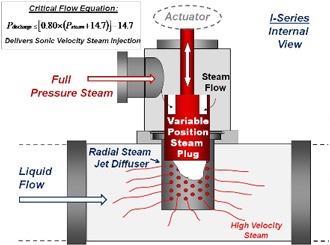
The PSX heater can be installed to heat up the process fluid prior to the flash vessel or recovery tank, and has a high heating capacity and can achieve up to a 250 °F temperature rise in a single pass. For difficult to pump slurries or unstable solvents, the PSX heater can be arranged in a Multi-stage configuration to stage the heating to optimize the process. The key to efficient, safe, and predictable steam injection is to inject steam at sonic velocity to achieve choked flow. By achieving choked flow, sonic velocity conditions can be achieved for steam injection. All steam injectors need to operate in a choked flow manner for good, non-violent mixing. The PSX heater is an internally modulated heater that varies the mass flow rate of steam by changing the area in which the steam may pass. This type of modulation allows the full steam pressure to always be present at the point of injection regardless of plug position. Flow rates can range from 1 – 10,000 gpm.
Key PSX Heater Direct Steam Injection Benefits
Eliminate Process Upsets as the internal steam control design of the PSX heater controls the steam mass flow and not the steam pressure thus eliminating steam hammer and vibration issues.
Lower maintenance due to the PSX heater’s self cleaning design (no scaling or plugging/fouling).
Low pressure drop (typically 1-2 psig) reduce pump integration issues and flow disruptions, and provides energy savings by lowering slurry pump demand.
Improved temperature control (typically +/- 1 °F) allows for a more reliable heating process.
Improved Reliability as a variety of alloys and wear coatings are available to address wear issues.
Inline process heating with Direct Steam Injection has multiple applications in a variety of process and utility applications. Many applications such as mineral processing, pulp and fiber slurry pre-treatment, oil sands mining and others are not well suited for traditional methods of heating. Typical challenges encountered are corrosive fluids, abrasive particulate, viscosity changes, plugging and fouling, eating for water, slurry, sludge, and aggressive fluid heating applications. Direct Steam Injection for Inline Heating is a very good choice for a variety of applications. One of the fundamental principals for efficient and reliable steam injection is the ability to produce and deliver high velocity steam. High velocity steam is what assures rapid and complete condensation and mixing of the steam in the fluid.
Internally Modulated Steam Control – ProSonix’s unique method of steam injection utilises an internal steam control to precisely deliver the appropriate mass flow of steam, and not the pressure, for the required heating. This is achieved via and integral pneumatic actuator, and a variable position stem plug in the steam jet diffuser. We do not throttle or regulate steam pressure. This design offers a precise method of steam control through a choked flow control delivery of the steam. ‘Choked flow’ is the phenomenon of accelerating a vapor to maximum velocity by creating a pressure differential through an engineered nozzle. By establishing choked flow, the steam mass flow can be metered to precisely control the heating of the liquid. This produces predictable results based on the position of the stem plug. Through a variable area steam diffuser, steam flow is metered at the point where steam and liquid first contact and mix. Internally Modulated DSI heating controls the mass flow of the steam and not the pressure.
Advantages with Multi-Stage DSI Heating
Eliminate process upsets as some fluids and slurries because of their hi-viscosity/hi-solids are not receptive to large volumes of steam addition. Splitting the heating load can result in improved steam condensation eliminating steam hammering (cavitation) and excessive wear
The PSX inline heater can be designed to match the slurry design flow velocities eliminating flow disruptions, accelerated flow velocity areas and maintaining solids in suspension
Rapid and complete condensation of the steam allows for more reliable temperature control of up to +/- 1°F (-17°C)
High velocity steam is self cleaning and eliminates issues associated with plugging and fouling along with scale and mineral build-up
Lower maintenance costs as proper condensation of the steam eliminates excessive wear, thus improving equipment reliability and life
Typically 1-2 psig reduces slurry pump demand which reduces energy consumption
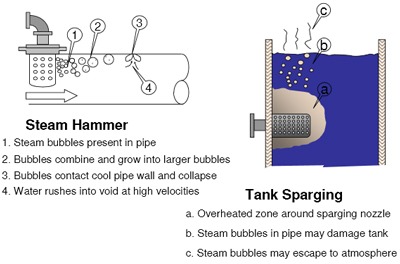
Jet Sparger Optimisation Heating of water tanks or vessels in many applications is done to stage hot water for use in production, cleaning, line and filter flushing and a number of other uses. Common methods of tank heating are through the use of heat exchangers, eductors or spargers. The incoming water is usually around 45°F – 60°F (7°C – 16°C) and is typically heated anywhere from 100°F – 150°F (38°C – 66°C) for applications involving sanitizing or cleaning.
Tanks and vessel systems typically heated by the use of heat exchangers, eductors, and steam spargers can experience the following issues:
Spargers and eductors may damage the tank because of the sometimes violent nature of the condensation process
Using an external steam control valve to control steam pressure produces low velocity steam which leads to inefficient steam mixing and condensation. Uncondensed steam will either produce steam hammering or escape to atmosphere leading to energy losses
Heat exchangers require a condensate return system. Plug and ineffective steam traps along with flash releases can lead to energy losses and maintenance issues
Heating of water can leave mineral and scale build-up that causes maintenance and performance problems for heat exchangers and spargers
Some sparger devices use passive springs and tube assemblies that tend to stick, resulting from scale build-up, causing temperature control problems
Jet Diffuser Efficiency
High velocity steam delivery assures complete mixing of steam, reducing occurrences of vibration and saves energy losses from uncondensed steam escaping. Integral stem plug eliminates need for steam pressure control valve.
Single or Multiple Jet Sparger Configurations
A single Jet Sparger can be used for small tanks. When heating larger tanks, or if a higher temperature rise is required, multiple PSX Spargers (2-4) can be placed around the tank. Multiple Jet Sparger configurations also allow for rapid heat-up, and when desired temperature is achieved, (1) PSX Jet Sparger can be operated for trim temperature control.
PSX Heater Solution
Install the PSX Jet Diffuser Tank Mount Sparger on the tank wall to the heat the tank until the tank reaches a steady state temperature. Various size tanks can be accommodated with single or multiple Jet Sparger arrangements.
The PSX heater has a high heating capacity which accelerates tank heat-up time over the time it takes conventional steam sparging. Once the desired tank temperature is achieved, a single the PSX heater steam injector can be operated to allow for trim temperature control of the tank until the desired tank temperature achieved. Injection of high velocity steam minimises improves condensation and mixing, thus structural damage to the tank from the sparger can be eliminated. As the PSX heater utilises sonic velocity steam injection, scale and mineral build issues in the steam injector is eliminated.
The tank temperature can be controlled via a tank sensor, a discharge sensor, a cascade control loop or in a variety of configurations allowing consistent precise temperature control. The internal steam control design of the PSX heater controls the steam mass flow and not the steam pressure, thus eliminating steam hammering and vibration.
Note: Use of tank sparging for applications above 150°F (66°C) may be inefficient and lead to extended heating times. For tank heating applications above 150°F (66°C), the PSX Inline heater is recommended.
Key Direct Steam Injection Benefits
Energy savings resulting from more efficient steam condensation, faster tank heat-up and reduced heat loss to atmosphere
Lower maintenance due to the PSX Jet Spargers self cleaning design
Improved safety due to better steam injection heating methods (elimination of steam hammering)
Better temperature control allows for a more reliable heating process
Reduced maintenance costs from the elimination of condensate return system
Wet end starch – Starch added at the wet end to the paper slurry can help increase the sheet strength. The starch will also act as binder for various additives and fillers such as Alum, Calcium carbonate and TiO2. When properly cooked, starch swells and its viscosity increases. Wet end starch is produced to give it a cationic charge. This allows the cooked starch natural adhesion properties to create a bond with the paper fibers. By connecting the fibers and additives in small ‘clumps’, leaving relatively clean water in between (flocculation), faster drainage of water leading to increased wire and machine speeds.
Size press starch – Many paper processes utilise a surface treatment known as sizing. Typically this is accomplished by applying a thin layer of starch during the drying of the paper in a section of the paper machine known as the size press. The function of the surface size treatment is to fill the voids in the paper sheet so any printing inks will sit on top the paper instead of penetrating into the sheet. Sized paper produces a clearer image when printed, than does un-sized, and allows for printing speeds through the printing press.
Issues Associated with Starch Cooking
Poor slurry make-down and batch cooking of starch experiences clumping of starch molecules. This can lead to uncooked starch granules being sent to the headbox, where they either plug the wire or drop into the white water system
Inconsistent starch viscosity can lead to build up on machine components. This starch buildup may eventually fall back onto the sheet, causing quality problems. If uncooked starch is present at the size press, it may cook on the sheet in the dryer section causing picks and tears in the sheet
Batch cooking of starch in tanks can lead to inconsistent viscosity and batch to batch quality issues
PSX Jet Cooker Key Benefits
More consistent starch viscosities
Inline starch cooking allows for better response to process changes such as solids (%) changes
OptiShearTM design allows for higher solids concentrations of starch slurry to be cooked
Adjustable condensing tube position allows for pressure drop adjustments to be made
Jet Cooker design promotes better mixing of steam and starch slurry for better cookout
Reduced starch consumption reduces costs. Better drainage reduces maintenance, lower white water contamination and improved product quality
Reduces localised wear issues associated with traditional Jet Cookers
PSX Jet Cooker Solution
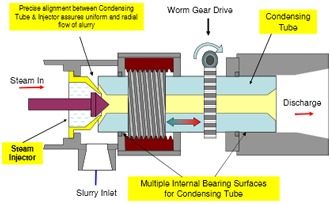
The PSX Jet Cooker is specifically designed for cooking starch slurries. The unique internal design of the Jet Cooker allows wet end starch slurry to be cooked at higher concentrations (6-10%) and higher temperatures of 220°F – 260°F (104°C – 127°C). Size press starch slurry can also be cooked at higher concentrations (up to 35% solids) and higher temperatures of 220°F – 320°F (104°C – 160°C). The PSX Jet Cooker design promotes a very thorough mixing of the steam and starch slurry, effectively cooking all of the starch instantly. The turbulent mixing affect breaks up clumps that would pass through other steam heating devices or batch processes. This helps to ensure that the starch entering the headbox is completely cooked and extremely consistent in viscosity and temperature.
Angled Steam Injector is designed for hi viscosity, hi solids and difficult to pump slurries and sludges
Low pressure drop of typically 1-2 psig
Precise temperature control to +/- 1°F (-17°C)
Expanded body allows for insertion of steam diffuser to maintain proper flow velocities thru heater
Single or multi-stage heating for flow rates from 1 – 10,000 gpm
High temperature rise up 250°F (121°C) in a single pass
Standard carbon steel or 316SS. Optional alloys and wear coatings available for erosive or corrosive applications
Designed to ASME B31.1; optional ASME, CRN or CE/PED certification
Well Suited For
High solids, high viscosity and difficult to pump slurries
Slurries with large particulate
Fibrous slurries such as pulp stock and biomass
Anaerobic digestion of municipal wastewater biosolids, animal by-products and biogas production
Mining and mineral processing applications
The ProSonixTM I-Series Direct Steam Injection heater’s unique method of direct steam injection utilises internal steam modulation via an integral pneumatic actuator to accurately deliver the appropriate mass flow of steam for the required heating. This modulating design offers a precise method of steam control through a choked flow control delivery of the steam. Choked flow is the phenomenon of accelerating a vapor to maximum velocity by creating a pressure differential through an engineered opening. By establishing choked flow, the steam mass flow is metered to precisely control the heating of the liquid. This produces predictable results based on position of the stem plug. Through a variable-area steam diffuser, steam flow is metered at the point where steam and liquid first contact and mix.
Features & Benefits
3-Dimensional steam injector delivers up, down and side to side steam injection pattern to optimise steam mixing and rapid condensation
Angled diffuser reduces flow disruptions and suitable for fibrous slurries
Single point steam injector diffuser connection allows for complete fluid pass through clearance with no build-up points for fibrous materials
Eliminates plugging and fouling from burn and scorch sensitive slurries and sludge’s
Internally modulated steam injection controls mass flow of steam allowing for smooth and stable operation
Energy savings as a result of low pressure drop across the PSX DSI heater
Positional steam inlet allows steam inlet flange to be rotated in 360° for ease of steam piping connection
Secondary internal steam shut-off (optional) for integral steam shut-off
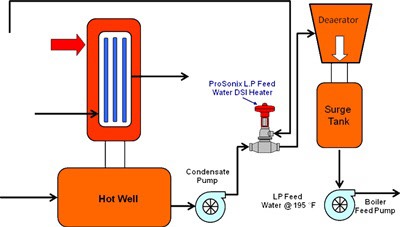
Boiler Feedwater Heaters via Direct Steam Injection
Power generating plants utilise steam boilers to produce electricity energy for their operation. These boilers often have feedwater heaters which are an integral part of the plant’s thermodynamic cycle. The presence of the heaters in the cycle improves the thermal efficiency of the power plant by lowering the amount of thermal energy required to generate a given amount of electrical by re-using produced steam in a heat exchanger to heat feedwater prior to the Deaerator.
Issues Associated with Boiler Feedwater Heating
Heat exchangers are prone to mineral and scale build-up on the internal components. This scale build-up reduces their thermal efficiency and requires costly cleaning and replacement of damaged components
Mineral and scale build-up can lead to a plugging/fouling issue which increases energy consumption from the condensate pumps
Replacement of the heat exchangers requires considerable floor space and foundation improvement because of their size, weight and cleaning access requirements
ProSonix Direct Steam Injection Heater Solution
The PSX heater can be installed to heat up the returned condensate with low pressure steam from the turbine. Often times steam temperatures of 600°F (316°C) and feedwater temps of 400°F (204°C) are not uncommon. The key to efficient, safe and predictable steam injection is the use of internally modulated steam control and to inject steam at sonic velocity to achieve choked flow. By achieving choked flow, sonic velocity conditions can be achieved for steam injection. The use of an integral pneumatic actuator allows for sonic velocity steam injection for the PSX Heater to operate in a choked flow manner for good, non-violent mixing. The PSX heater is an internally modulated heater, with a variable position stem plug, that varies the mass flow rate of steam by changing the area in which the steam may pass. This type of modulation allows the full steam pressure to always be present at the point of injection, regardless of plug position.
Key PSX Heater Direct Steam Injection Benefits
Stable operation the internally modulated steam control design of the PSX heater controls the steam mass flow and not the steam pressure, thus eliminating steam hammer and vibration issues
Lower maintenance due to the PSX heater’s self cleaning design (no scaling or plugging/fouling)
Low pressure drop across the PSX Heater (typically 1-2 psig) reduce pump integration issues and flow disruptions
Economical installation as the PSX heater can be installed in the piping with no floor space requirements
Precise temperature control, typically +/- 1°F (-17°C), allows for a more reliable heating process
High turndown on both steam and liquid allow for process flexibility and process condition variations


 Wet end starch – Starch added at the wet end to the paper slurry can help increase the sheet strength. The starch will also act as binder for various additives and fillers such as Alum, Calcium carbonate and TiO2. When properly cooked, starch swells and its viscosity increases. Wet end starch is produced to give it a cationic charge. This allows the cooked starch natural adhesion properties to create a bond with the paper fibers. By connecting the fibers and additives in small ‘clumps’, leaving relatively clean water in between (flocculation), faster drainage of water leading to increased wire and machine speeds.
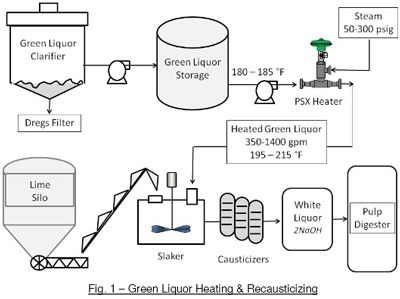 Kraft pulp mills produce pulp from wood chips. Within the pulp production, a chemical process produces green liquor. Green liquor is a combination of recovery boiler smelt and dilute white liquor. Dregs are removed and liquor is sent to recausticising tanks to produce white liquor. Flows vary based on the size of the pulp mill and can range from 350-1400 gpm.
 White water is a fine particle slurry used throughout the paper making process. Its name derives from fine fiber particles in the water that give it a milky white appearance. White water drains from the paper stock into a pit below the paper machine and is used for a variety of uses in the paper making process.


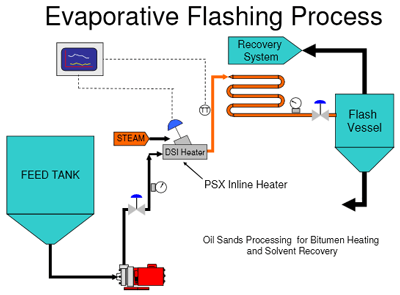 Oil sands processing in Northern Canada utilizes a variety of solvents and naphtha to assist in the separation of the Bitumen from the water and sand. These fluids can help promote chemical reactions, accelerate processing time, and reduce processing costs. Many of these
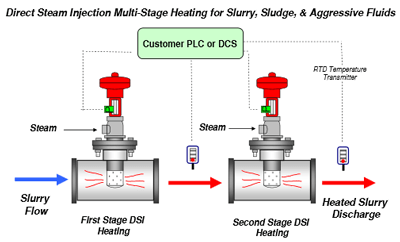 Inline process heating with Direct Steam Injection has multiple applications in a variety of process and utility applications. Many applications such as mineral processing, pulp and fiber slurry pre-treatment, oil sands mining and others are not well suited for traditional methods of heating. Typical challenges encountered are corrosive fluids, abrasive particulate, viscosity changes, plugging and fouling, eating for water, slurry, sludge, and aggressive fluid heating applications. Direct Steam Injection for Inline Heating is a very good choice for a variety of applications. One of the fundamental principals for efficient and reliable steam injection is the ability to produce and deliver high velocity steam. High velocity steam is what assures rapid and complete condensation and mixing of the steam in the fluid.