We offer a range of steam injection solutions designed for efficient, direct-contact heating across a wide variety of industrial processes. Our steam injectors provide rapid and uniform heat transfer by injecting steam directly into liquids, helping to achieve precise temperature control, improved heating efficiency, and reduced energy consumption.
Our steam injection technology is suitable for numerous applications, including hot water supply, tank heating, inline process water heating, boiler feedwater heating, starch processing, biofuel production, food processing, mining, and wastewater treatment. Whether used for heating process fluids, supporting production processes, or recovering waste steam, these solutions help optimise thermal performance and overall system efficiency.
Designed for demanding industrial environments, our steam injectors offer reliable performance, efficient operation, and versatile application across industries such as power generation, food and beverage, pulp and paper, mining, and manufacturing. Whether you require heating for an existing system or a specialised process application, we provide effective steam injection solutions backed by technical expertise and support.
Jet Sparger Optimisation Heating of water tanks or vessels in many applications is done to stage hot water for use in production, cleaning, line and filter flushing and a number of other uses. Common methods of tank heating are through the use of heat exchangers, eductors or spargers. The incoming water is usually around 45°F – 60°F (7°C – 16°C) and is typically heated anywhere from 100°F – 150°F (38°C – 66°C) for applications involving sanitizing or cleaning.
Tanks and vessel systems typically heated by the use of heat exchangers, eductors, and steam spargers can experience the following issues:
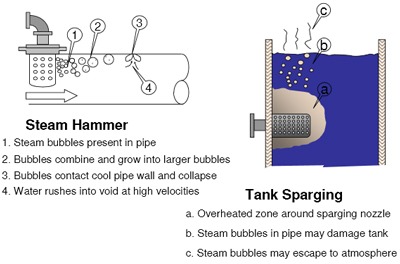
Spargers and eductors may damage the tank because of the sometimes violent nature of the condensation process
Using an external steam control valve to control steam pressure produces low velocity steam which leads to inefficient steam mixing and condensation. Uncondensed steam will either produce steam hammering or escape to atmosphere leading to energy losses
Heat exchangers require a condensate return system. Plug and ineffective steam traps along with flash releases can lead to energy losses and maintenance issues
Heating of water can leave mineral and scale build-up that causes maintenance and performance problems for heat exchangers and spargers
Some sparger devices use passive springs and tube assemblies that tend to stick, resulting from scale build-up, causing temperature control problems
Jet Diffuser Efficiency
High velocity steam delivery assures complete mixing of steam, reducing occurrences of vibration and saves energy losses from uncondensed steam escaping. Integral stem plug eliminates need for steam pressure control valve.
Single or Multiple Jet Sparger Configurations
A single Jet Sparger can be used for small tanks. When heating larger tanks, or if a higher temperature rise is required, multiple PSX Spargers (2-4) can be placed around the tank. Multiple Jet Sparger configurations also allow for rapid heat-up, and when desired temperature is achieved, (1) PSX Jet Sparger can be operated for trim temperature control.
PSX Heater Solution
Install the PSX Jet Diffuser Tank Mount Sparger on the tank wall to the heat the tank until the tank reaches a steady state temperature. Various size tanks can be accommodated with single or multiple Jet Sparger arrangements.
The PSX heater has a high heating capacity which accelerates tank heat-up time over the time it takes conventional steam sparging. Once the desired tank temperature is achieved, a single the PSX heater steam injector can be operated to allow for trim temperature control of the tank until the desired tank temperature achieved. Injection of high velocity steam minimises improves condensation and mixing, thus structural damage to the tank from the sparger can be eliminated. As the PSX heater utilises sonic velocity steam injection, scale and mineral build issues in the steam injector is eliminated.
The tank temperature can be controlled via a tank sensor, a discharge sensor, a cascade control loop or in a variety of configurations allowing consistent precise temperature control. The internal steam control design of the PSX heater controls the steam mass flow and not the steam pressure, thus eliminating steam hammering and vibration.
Note: Use of tank sparging for applications above 150°F (66°C) may be inefficient and lead to extended heating times. For tank heating applications above 150°F (66°C), the PSX Inline heater is recommended.
Key Direct Steam Injection Benefits
Energy savings resulting from more efficient steam condensation, faster tank heat-up and reduced heat loss to atmosphere
Lower maintenance due to the PSX Jet Spargers self cleaning design
Improved safety due to better steam injection heating methods (elimination of steam hammering)
Better temperature control allows for a more reliable heating process
Reduced maintenance costs from the elimination of condensate return system